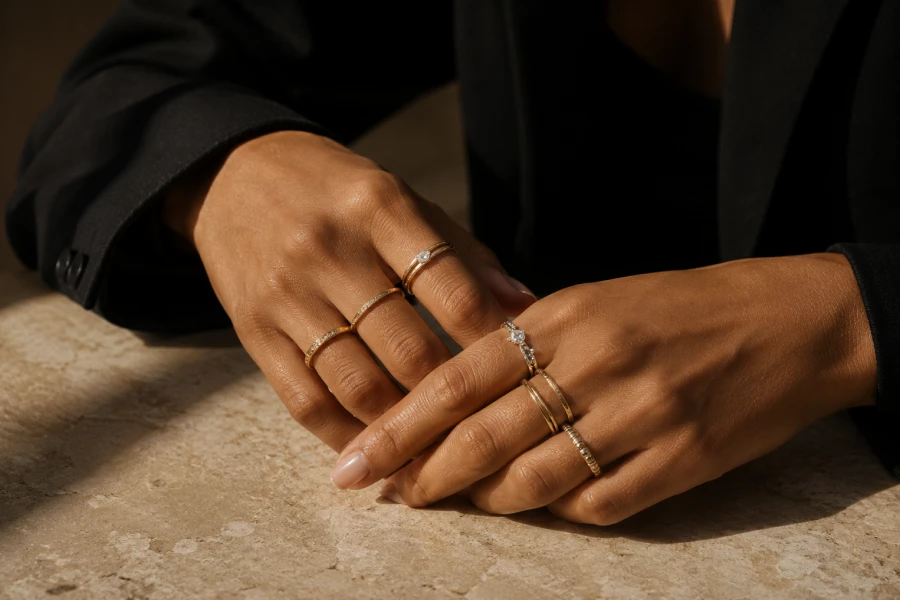
Jewelry layering looks effortless only when every ring contributes to one readable composition. Stackable ring combinations work best when they create rhythm rather than uninterrupted sparkle across every finger. Begin with one piece that carries the strongest shape, stone, texture, or emotional meaning. That ring becomes the anchor, while supporting bands repeat or soften its visual language. Leaving space around the anchor helps its details remain visible during normal movement. It also prevents smaller designs from disappearing beneath a crowded arrangement. Thoughtful ring stacking ideas for a balanced ring stack begin with hierarchy, not with the number of pieces owned. The goal is cohesion that still allows each ring to retain its identity. A stack should look considered from several angles, including when the hand rests naturally. Intentional restraint often creates more impact than filling every available space.
A visual anchor gives the eye somewhere to begin before exploring finer details. Choose the ring you would still wear if every supporting band disappeared. Its profile, finish, and scale should influence the remaining decisions. A raised gemstone may need thin companions that avoid rubbing against its setting. A wide sculptural band often looks strongest beside one delicate line rather than several medium widths. Repeating a small feature creates connection without requiring exact matching. That feature might be a milgrain edge, a geometric angle, or a shared metal tone. A balanced ring stack feels related even when individual pieces come from different collections. Avoid placing equal visual weight on every ring, because the composition loses direction. Clear hierarchy turns variety into a deliberate signature instead of accidental accumulation.
Width and height affect both appearance and how comfortably fingers close together. Combine one substantial band with slimmer pieces to create contrast and breathing room. Rings with high settings need enough clearance to avoid catching against neighboring stones. Low profiles can sit closer, but they still require space for skin movement. Check the stack while making a fist, holding a phone, and carrying a bag. A composition that looks beautiful on a flat hand may feel restrictive during ordinary tasks. Leave one finger quieter when several others carry noticeable detail. That pause gives the arrangement rhythm and prevents sparkle from becoming visually flat. Proportion should follow hand scale, finger length, and personal comfort rather than rigid rules. The best result feels balanced before anyone analyzes the individual components.
Comfort determines whether a striking arrangement becomes part of real life or stays inside a jewelry box. Test edges for rubbing, spinning, pinching, and contact with adjacent fingers. Slightly varied ring sizes may improve stability when bands stack above the knuckle. Place smoother pieces where movement creates friction, especially during long workdays. Reserve taller or sharper settings for positions that experience less contact. Practical everyday ring styling respects typing, driving, washing, and frequent hand use. Remove one band if the stack requires constant adjustment throughout the day. Discomfort changes how the hand moves, which can make even beautiful jewelry appear awkward. A wearable arrangement should feel secure without demanding attention every few minutes. Comfort supports elegance because relaxed movement lets the design appear naturally integrated.
Mixing metals becomes coherent when one detail repeats across the entire arrangement. Use a two-tone ring as a bridge between gold, silver, or rose-toned pieces. Without a bridge, repeat each metal at least twice so neither appears accidental. Similar finishes can also connect different colors, such as polished surfaces or softly brushed textures. Keep gemstone color simple while the metal story carries most of the contrast. Alternatively, repeat one stone shade across several metals for a richer layered effect. Well-planned mixed metal rings look collected over time rather than purchased as a matching set. Avoid distributing every metal equally if one tone clearly suits your wardrobe or skin preference. Let the dominant metal create continuity while the secondary tone adds brightness. Repetition transforms contrast from a styling risk into a recognizable design choice.
A ring arrangement can change mood without requiring an entirely different jewelry collection. For quiet mornings, combine smooth bands with one small stone and generous open space. Work settings often suit lower profiles that feel polished without interfering with movement. Evening looks can introduce stronger contrast, larger scale, or concentrated sparkle on one hand. Weekend styling may welcome playful asymmetry, colored stones, or an unexpected thumb ring. Keep one recognizable element across these versions so the collection still feels personal. That element could be a favorite signet, heirloom band, or repeated metal combination. Mood changes should alter emphasis rather than erase the wearer behind the jewelry. Flexible styling makes each ring more useful across seasons and occasions. The strongest collection supports different expressions while preserving a consistent point of view.
More rings do not automatically create more dimension, especially when every surface competes equally. Photograph the arrangement from above, from the side, and with the hand relaxed. Images reveal crowding that a close mirror view often hides. Remove the least distinctive band, then compare the composition before replacing anything. Clean the remaining pieces because dull surfaces can make a stack appear heavier. Rotate rings between fingers instead of assuming each one has a permanent position. Review another perspective on building a recognizable jewelry signature before purchasing another filler band. Editing develops stronger judgment about scale, repetition, and meaningful contrast. A finished stack should feel complete even when it contains only two pieces. Confidence appears when every ring earns its place and nothing feels added from uncertainty.


Leave a comment